
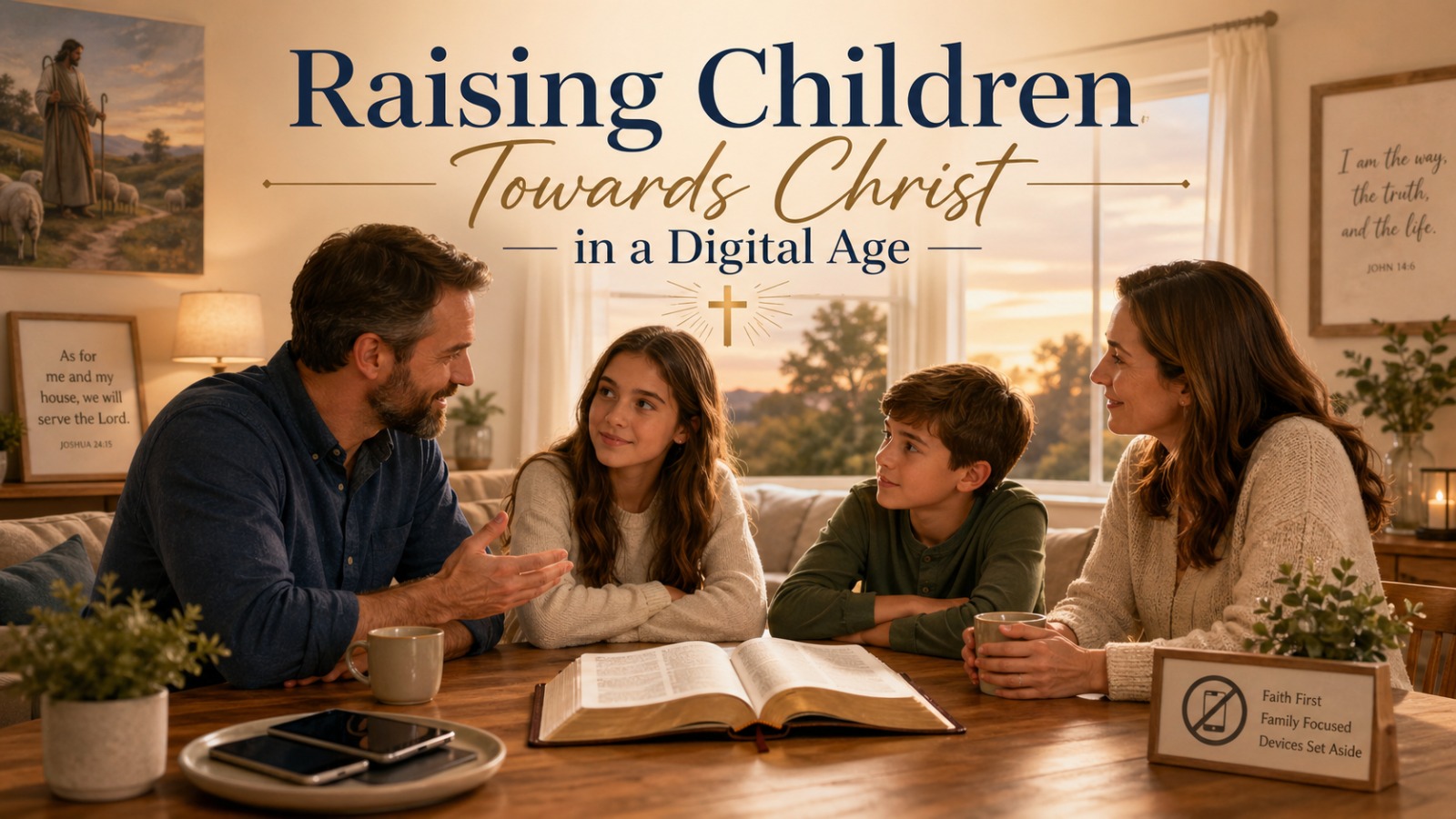
Raising Children Towards Christ in a Digital Age
Jabez had just returned from a two-day parenting conference. One question kept troubling him: Should I install a parental control app to watch his daughter’s online activity?
His concern was not only internet safety. Would his daughter see him as a loving father who wanted to protect her, or as a policeman watching every move? Should he give her full freedom, or should he set clear boundaries?
Many Christian parents feel this tension. We want to protect our children without losing their trust. We want to guide them without crushing them. We want them to grow wisely, but they are growing up in a world very different from the one we knew.
The internet, globalization, artificial intelligence, medical progress, social media, and multiculturalism have changed family life. These developments bring many benefits, but they also bring pressure, distraction, confusion, and temptation into the home. For Christian parents, the goal is not simply to manage behaviour, control screens, or keep children safe. The deeper calling is to guide children toward Christ, so that their minds, hearts, desires, and actions are gradually shaped into His likeness. Paul describes this as being “conformed to the image of his Son” (Romans 8:29).
The World Shaping Our Children
The internet has placed the world in a child’s hand. Through one device, children can access education, entertainment, friendships, opinions, and temptations. Globalization and multiculturalism expose them to many beliefs and values. Medical progress raises new questions about the body, identity, and human dignity. Artificial intelligence can assist learning, but it cannot form wisdom or character.
Christian parents must therefore avoid two mistakes: rejecting the modern world completely, or embracing it uncritically as though progress automatically produces wisdom. A phone may provide information, but it cannot give character. AI may give answers, but it cannot teach a child how to live. Social media may create connection, but it cannot replace real friendship, family worship, or honest conversation.
The Deeper Issue: Identity and Restoration
Social media does more than fill time; it quietly shapes the way children see themselves. It teaches them to compare, perform, display, and measure their worth through likes, comments, appearance, achievement, and popularity. Over time, children begin to ask, “Who am I? Am I accepted? Am I good enough?”
The issue is not only screen time. The deeper issue is identity.
The Bible gives children a stronger foundation. They are not self-created. They are created by God. Genesis tells us that God created human beings in His own image (Genesis 1:27; 5:1–2). This means every child has dignity, value, and purpose. Their worth is not decided by online attention, school results, beauty, success, or popularity. Their worth begins with God, who made them.
Yet because sin has damaged human life, children need more than confidence. They need restoration in Christ. Jesus is “the image of the invisible God” (Colossians 1:15), and God’s purpose is that His people be conformed to the image of His Son (Romans 8:29). This restoration is not vague. Paul describes it as being “renewed in knowledge after the image of its creator” (Colossians 3:10) and being created “after the likeness of God in true righteousness and holiness” (Ephesians 4:24). Christ Himself becomes our wisdom, righteousness, sanctification, and redemption (1 Corinthians 1:30).
This gives parents a simple and powerful framework: head, heart, and hand. Children need the knowledge of God in the head, so they know who God is, who they are, and why they exist. This knowledge is not mere information; it is wisdom that begins with Christ. They need holiness in the heart, so their desires, loves, habits, and choices are shaped by what pleases God. They need righteousness in the hand, so they learn to do what is right before God and others.
In other words, God’s Word moves from the head to the heart and then to the hand. As children read, hear, memorise, discuss, and obey Scripture, they receive a better story than the world gives them. The world says, “Create yourself.” The gospel says, “You are created by God, restored in Christ, and called to reflect His image.”
Christ at the Centre of the Home
In many homes today, the child slowly becomes the centre. The child’s preferences, moods, achievements, and demands begin to rule family life. Loving children is right. Making them the centre is not.
A Christian home must be centred on Christ and the gospel. Children are loved, heard, corrected, and guided, but they are not enthroned. When Christ is at the centre, the home is not ruled by screens, moods, comparison, or personal demands. It is shaped by worship, truth, service, forgiveness, discipline, and love.
For Jabez, this changed the whole question. His home was not a battlefield over devices, but a mission field for Christ. His calling was not merely to install an app or prevent danger, but to shepherd his daughter, himself, and his whole household toward the image of Christ.
Fatherly Love and Shepherding Care
Jabez needed more than a digital strategy. He needed to become a father who reflected the love of the heavenly Father and the shepherding care of Christ. Christian parenting holds together fatherly discipline and shepherdly presence.
Children need boundaries. Proverbs says, “Train up a child in the way he should go” (Proverbs 22:6). Hebrews reminds us that “the Lord disciplines the one he loves” (Hebrews 12:6). Discipline is not the opposite of love. Discipline is love taking responsibility.
But discipline must be done rightly. It must not be harsh, angry, suspicious, or humiliating. It should be firm, clear, consistent, and affectionate. Boundaries are not meant to destroy joy; they are meant to protect what is good.
Parents must also shepherd their children. Jesus said, “I am the good shepherd” (John 10:11). A shepherd does not shout commands from a distance. He knows, leads, protects, and walks with the sheep. Psalm 23 shows the Lord leading, restoring, comforting, and staying with His people even in the valley.
This is especially important during the teenage and university years. Young people face pressure, temptation, identity confusion, loneliness, and doubt. They need parents who are present, calm, engaged, and willing to listen before correcting. Jesus walking with the disciples on the road to Emmaus gives a beautiful pattern (Luke 24:13–35). He came near, walked with them, listened, asked questions, corrected them, and opened the Scriptures. Parents must learn to do the same.
Boundaries as Love in Action
Because Christ is at the centre of the home, boundaries are necessary. Boundaries are not the opposite of love; they are one way love protects what is good. Paul gives a helpful principle for digital life: “‘I have the right to do anything,’ you say—but not everything is beneficial… not everything is constructive” (1 Corinthians 10:23). A family may have access to phones, laptops, entertainment, YouTube, and social media, but not everything builds the home or strengthens the heart.
Ten Digital Boundaries for Christian Homes
- Thou shall not keep devices in bedrooms. Charge phones, laptops, and tablets outside bedrooms.
- Thou shall not use screens immediately after school or university. Give priority to outdoor play, sports, exercise, rest, homework, and family conversation.
- Thou shall not use entertainment screens for more than one hour a day. Leave room for reading, prayer, creativity, and sleep.
- Thou shall not use devices during mealtimes. Protect the table for conversation and family connection.
- Thou shall not have social media without maturity and parental guidance. Delay it as long as possible; when allowed, keep it limited and discussed.
- Thou shall not post or tag others without permission. Respect privacy and dignity, because every person is made in God’s image.
- Thou shall not scroll mindlessly. Use devices with purpose, not as a habit of escape.
- Thou shall not watch YouTube without purpose or guidance. Use it mainly for study or approved content.
- Thou shall not fill the heart with harmful songs or content. “Guard your heart” (Proverbs 4:23).
- Thou shall not forget a screen-free Sabbath. Let the Lord’s Day be marked by worship, rest, fellowship, and attention to God.
These boundaries are not only for children. Parents must model them. The rule of the home must be shared: Christ first, people next, devices last.
Conclusion
Jabez began by asking whether he should install a parental control app. But the issue was bigger than an app. His daughter did not need surveillance or unrestricted freedom. She needed a father who would love her wisely, set boundaries tenderly, listen patiently, and walk with her toward Christ.
This is the calling of the Christian home. It is not a place where the child is the centre, nor where screens quietly rule the family. It is a mission field where Christ and the gospel stand at the centre.
Parents must help their children grow in the knowledge of God, holiness, and righteousness. They must teach God’s Word, guard the heart, shape habits, and model what they teach. In a world that tells children to create themselves, Christian parents must help them know the God who created them, the Christ who restores them, and the Spirit who transforms them into the image of Jesus Christ.
✍ Pearline Peter and Peter Joseph
Global Discipleship Renewal Ministries